












































 Benny Hinn Ministries
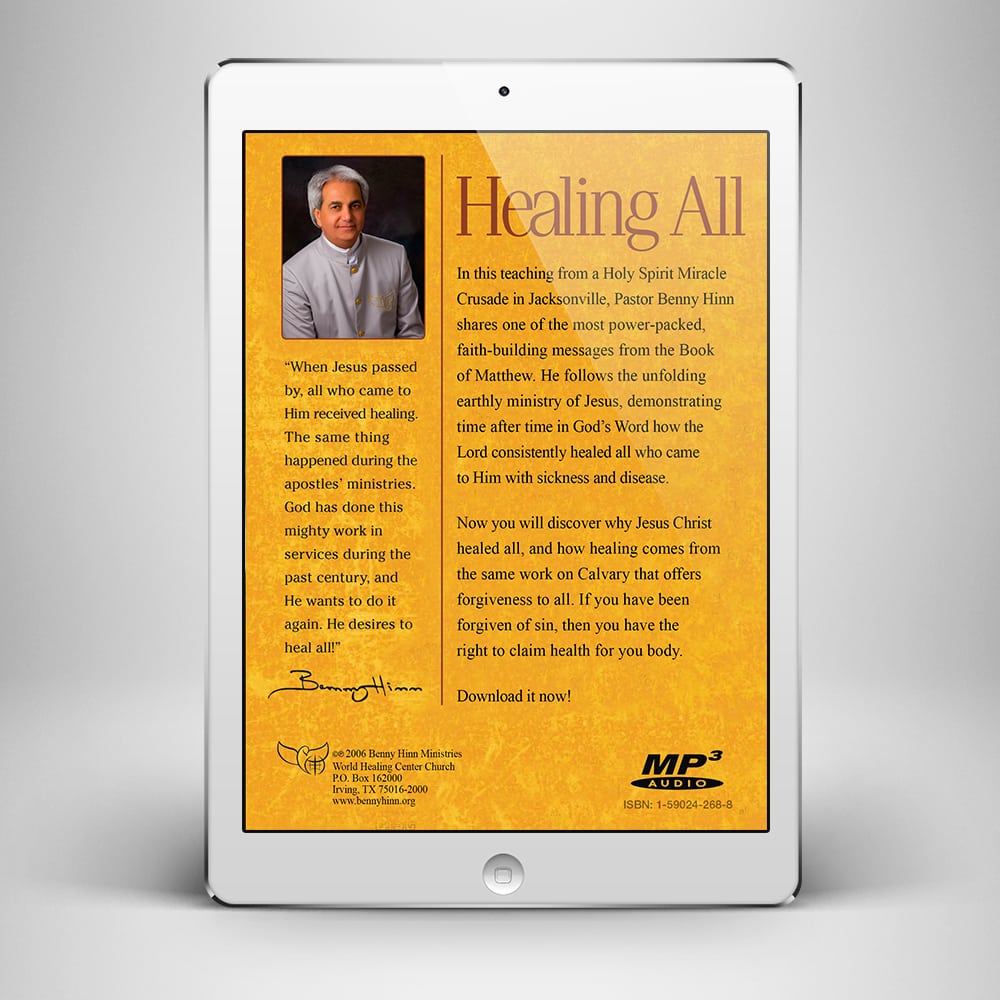

In this teaching from a Holy Spirit Miracle Crusade in Jacksonville, Pastor Benny Hinn shares one of the most power-packed, faith-building messages from the Book of Matthew. He follows the unfolding earthly ministry of Jesus, demonstrating time after time in God’s Word how the Lord consistently healed all who came to Him with sickness and disease. Discover why Jesus Christ healed all, and how healing comes from the same work on Calvary that offers forgiveness to all.
Healing All
$8.00
SKU: CD055-DD
Categories: All Products, Digital Downloads, Faith & Healing, Health & Wellness, Jesus Revealed, Teaching
Tags: Benny Hinn, digital download, faith, Healing, MP3
Description
In this digital download, you will discover why Jesus Christ healed all.
- 42 minutes of a faith-building message from Pastor Benny Hinn
- Files are in MP3 format (the most compatible, high-quality digital files)
- Listen on your computer or mobile device
- Compatible with Android, Apple, Microsoft devices and more…
Be the first to review “Healing All” Cancel reply
Frequently Asked Questions & Answers
- What is a digital download?
A digital download will allow you to instantly download and enjoy this teaching rather than waiting a few days for a physical product to be shipped to you. - Will I still receive a physical CD or DVD of this teaching?
We are able to offer these teachings to you at a lower cost because the product is delivered to you instantly over the internet via download. You will not receive a physical CD or DVD with your order. When you purchase this product, you are ordering a digital product only. - When do I receive my digital download link?
Your download link can be found in your order confirmation email. This email should arrive instantly. Be sure to check your spam folder if you do not receive a confirmation email within 5 minutes of your purchase. - How do I download my copy?
Follow these steps: (1) Click the link in your order confirmation email. (2) Click "save" to save your copy to the desired location on your computer. (3) Click the file to unzip and enjoy. - Does my digital download link expire?
Your download link expires 30 days from the date of purchase or after 3 downloads (whichever comes first). - May I share my file with others?
When you request a digital download from www.BennyHinn.org, you are purchasing a license for personal use only. Please do not redistribute or resell your digital copy. To learn more please see our terms of use policy. - Will I receive a Benny Hinn School of Ministry Online Certificate when I order this downloadable product?
No. To receive the credentials associated with a particular Benny Hinn School of Ministry course, you must enroll in that course and complete the class requirements. Only registered students at www.BennyHinnBibleStudy.org will receive a Certificate of Completion. - What if need further assistance?
For more information click "Help?" at the top of your screen to access the new Partner Assistance area at www.bennyhinn.org/help








Reviews
There are no reviews yet.